
Why the Current System for Licensing User-Generated Content Is Broken
News organizations and creators both lose under today's informal social-media licensing process. Here's how a better system can benefit everyone.
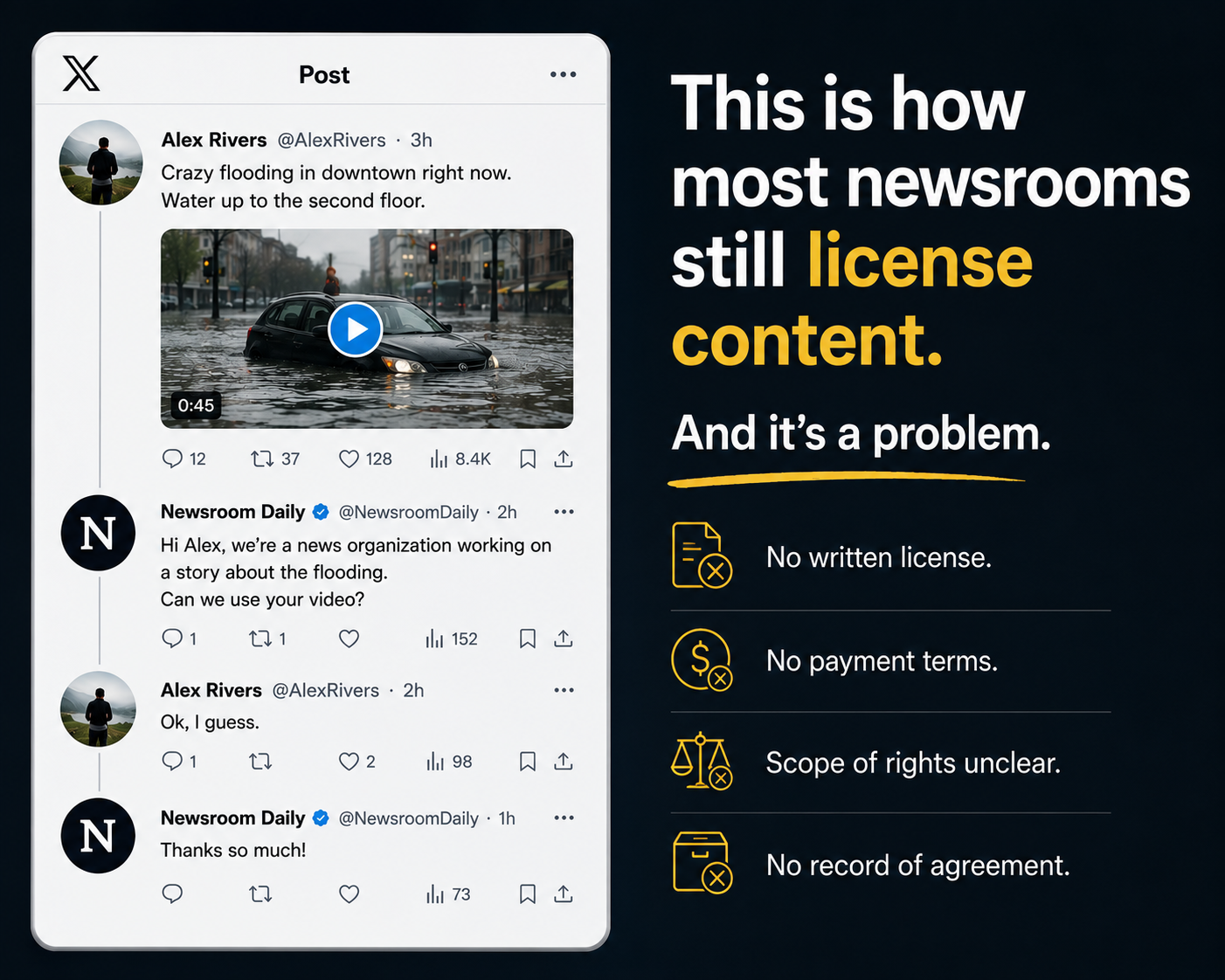
Every day, journalists scour social media looking for compelling videos, photos, and eyewitness accounts.
A dramatic storm captured on a smartphone. A once-in-a-lifetime animal encounter. A powerful moment from a protest, sporting event, or neighborhood celebration. Increasingly, some of the most important and engaging content on the internet isn't produced by professional news crews—it's created by ordinary people who happened to be in the right place at the right time.
When news organizations want to use this content, the process is surprisingly informal.
A producer spots a video on TikTok, Instagram, YouTube, X, or Reddit and sends a direct message:
"Can we use your video on our platforms? Please reply with permission."
If the creator responds affirmatively, the content may end up reaching millions of viewers.
This approach has become so common that many creators don't think twice about it. They simply reply "sure" and move on.
But the reality is that this system is failing both creators and news organizations.
Creators Often Don't Understand the Value of What They're Giving Away
Most people don't wake up hoping to become content licensors.
They're dog owners, parents, travelers, hikers, commuters, and hobbyists. They post a video because they think it's interesting or entertaining—not because they're looking to negotiate media rights.
As a result, many creators grant permission without understanding:
How broadly their content may be used
How long the permission may last
Whether other organizations may also want to license the content
Whether the content has commercial value
Some creators later discover that their video appeared on television, news websites, streaming services, or social channels viewed by millions of people.
Others are contacted by multiple organizations and have no idea whether they're allowed to grant rights to more than one outlet, charge a fee, or negotiate different terms.
The result is often regret, confusion, or missed opportunities.
News Organizations Face Their Own Challenges
The current system isn't ideal for journalists either.
Finding the creator is only the beginning.
Newsrooms must determine:
Whether the account actually owns the content
Whether the content is authentic
Whether the creator has already granted rights elsewhere
Whether the person responding to the message is authorized to license the content
Whether the outlet has adequate documentation of the permission
These questions have become more important as AI-generated media, reposted content, impersonation accounts, and viral-content agencies have proliferated online.
What appears to be a straightforward licensing request can quickly turn into a rights-clearance exercise.
And because the process often happens over social media direct messages, it can be difficult to maintain consistent records and workflows.
The Hidden Cost of Friction
The biggest casualty of the current system is efficiency.
Creators don't know what their content is worth.
Journalists don't know whether the content is authentic or properly licensed.
Both sides spend time navigating a process that was never really designed for rights transactions in the first place.
In many cases, valuable content simply goes unused because reaching the creator takes too long, verifying ownership is too difficult, or the licensing path is unclear.
A Better Approach
Chauncy was built to address this gap.
Instead of relying on ad hoc direct messages and guesswork, Chauncy helps connect news organizations and creators through a more structured, yet streamlined process.
Instead of relying on informal direct messages, fragmented email chains, and vague permission grants, Chauncy enables creators and news organizations to complete the entire licensing process through a single streamlined workflow.
News organizations can quickly identify and contact creators, make a licensing offer, negotiate terms if necessary, execute a clear written license agreement, and submit payment—all in one place.
Creators can review offers, understand exactly what rights they are granting, electronically sign a written agreement, and receive payment without having to navigate legal jargon, invoicing systems, or endless back-and-forth communications.
The result is a process that is faster for journalists, clearer for creators, and more reliable for both sides. Instead of wondering whether a social media reply constitutes adequate permission or whether payment was ever discussed, everyone walks away with a documented agreement, a shared understanding of the rights involved, and a complete record of the transaction.
By bringing communication, contracting, and payment into a single workflow, Chauncy transforms what has traditionally been an informal and often confusing process into a professional marketplace that benefits everyone involved.
User-Generated Content Isn't Going Away
The role of creator-captured content in journalism will only continue to grow.
The challenge isn't whether news organizations will use content from social media. They already do.
The challenge is building systems that make the process more transparent, more efficient, and more equitable for everyone involved.
The internet has evolved dramatically over the last decade.
The way we license content should evolve too.